Citibank is stepping aside as the bank in charge of making payments on bonds issued by Venezuelan state oil company PDVSA, according to three sources with knowledge of the matter and a letter to bondholders seen by Reuters.
Citibank in July told bondholders PDVSA would need to name a new paying agent for seven outstanding dollar-denominated bonds that the bank has represented, according to three investors who asked not to be identified.
A letter from Citibank to bondholders seen by Reuters said the bank would no longer serve as paying agent for PDVSA's 2017N bond that bears an 8.5 percent coupon.
The letter did not describe the reason for the decision.
A spokeswoman for Citibank, a unit of Citigroup, confirmed the veracity of the letter but said the bank could not offer additional details, citing company policy of not commenting on issues involving clients. PDVSA did not respond to a request for comment.
Investors said they received similar letters from Citibank regarding bonds maturing in 2016, 2021, 2022, 2024, 2026 y 2035.
Citibank declined to comment on those letters.
Paying agents are charged with receiving funds from the issuer of a bond and disbursing those funds to bondholders.
Citibank in July said it planned to halt correspondent bank services for the Venezuelan government's foreign currency accounts, citing a periodic risk management review.
President Nicolas Maduro said the move was part of a "blockade."
PDVSA, which is struggling under low oil prices and a collapsing socialist economy, in November must make a $2.05 billion amortization on the 2017N bond and a $1 billion maturity payment on its 2016 global bond.
PDVSA President Eulogio del Pino has said the company is interested in swapping the 2017 bonds for later maturities.
The company has begun discussions with Credit Suisse for a possible swap of 2017 bonds, sources familiar with the discussions told Reuters this month.
But investors and bondholders consulted by Reuters say they have not been approached about such an offer.
(Additional reporting by Alexandra Ulmer, writing by Brian Ellsworth; Editing by Bernard Orr)
Kunden der Deutschen Bank, die in die börsengehandelte Goldanleihe Xetra-Gold investiert haben, könnten aktuell auf Schwierigkeiten stoßen, wenn sie sich ihre Anlage in Form von physischem Gold ausliefern lassen wollen. Wie die Webseite Godmode-Trader.de gestern berichtete, bietet die Deutsche Bank diese "Dienstleistung" derzeit offenbar nicht mehr an.
Bei Xetra-Gold handelt es sich um eine Schuldverschreibung der Deutsche Börse Commodities GmbH, die nach Angaben der offiziellen Webseite "den Anspruch auf jederzeitige Auslieferung von Goldbarren" verbrieft. Das Gold wird zum Teil im Auftrag des Emittenten von der Clearstream Banking AG in physischer Form Frankfurt verwahrt und zum Teil in Form von Buchgoldansprüchen gegenüber der Umicore AG & Co. KG geführt.
Die physische Auslieferung gestaltet sich aber zumindest für Kunden der Deutschen Bank derzeit schwierig. Wie aus dem Artikel von Godmode Trader hervorgeht, wurde sie einem Anleger kürzlich "aus geschäftspolitischen Gründen" verweigert, nachdem dieser sich zur Ausübung der Goldanleihen wie in den Produktinformationen beschrieben an seine Hausbank gewendet hatte.
Das ist besonders bemerkenswert, da in den Informationen zur Ausübung der Goldanleihen eindeutig erklärt ist, dass die Deutsche Bank AG als emissionsbegleitendes Institut die physischen Auslieferungen durchführt (Hinweise zum Prozess der Ausübung von Xetra-Gold, S. 3)
Nicht abschließend geklärt ist derzeit, ob die Auslieferung über andere Banken weiterhin angeboten wird. Nach Angaben von Godmode Trader rät die Deutsche Börse Commodities GmbH dazu, Anteile an Xetra-Gold an eine Volks-/Raiffeisenbank zu übertragen, da die Ausübung des verbrieften Rechts auf die Lieferung des Edelmetall auf diesem Wege noch möglich sei.
Abgesehen davon bleibt den Anlegern die Möglichkeit, ihre Anteile an den Goldanleihen an der Börse zu verkaufen und für den Erlös Münzen oder Barren im Einzelhandel zu erwerben. Dann stellt sich allerdings die Frage, welchen Zweck ein Finanzprodukt erfüllt, das den Anspruch auf physisches Edelmetall zusichert, die Auslieferung jedoch nicht garantieren kann.
13 Milliarden Euro NachzahlungAmerikas Senat brachte die EU auf Apples Fährte
Nach der Entscheidung der EU-Kommission gegen Apple äußern sich amerikanische Politiker empört. Dabei haben offenbar gerade sie die Ermittlungen ursprünglich ausgelöst.
Die EU-Kommission erlegt dem Technologie-Unternehmen Apple eine bis zu 13 Milliarden Euro umfassende Steuernachzahlung auf. Ein Paukenschlag. Der Protest von Seiten des Unternehmens folgte umgehend, der Fall wird vor Gericht gehen.
Auch amerikanische Politiker zeigten sich erzürnt. Kurios vor diesem Hintergrund ist: Offenbar hat ein Untersuchungsbericht des amerikanischen Senats in Washington das Vorgehen der EU gegen Apple erst ausgelöst.
„Schäme dich Apple“
Das berichtet der amerikanische Finanzsender CNBC. Demnach hat der Senat, eine der beiden Kammern des Kongresses, im Mai 2013 den nun verurteilten Steuerdeal zwischen Apple und der irischen Regierung offengelegt.
Carl Levin, der demokratische Politiker, der damals dem entsprechenden Ausschuss leitete, sagt nun, drei Jahre später, auch ganz klar: Die Europäer würden nur versuchten einzuziehen, was den Amerikanern nicht gelungen sei - weil die Vereinigten Staaten entsprechende Schlupflöcher nicht hätten stopfen können, die Konzernen ermöglichen, Gewinne in Übersee zu horten.
„Europa versucht, dieses Vakuum zu füllen. Schäme dich Apple, das versucht hat, amerikanische Steuern zu vermeiden. Schäme dich IRS, die nicht in der Lage war, Apples Steuer-Vermeidung anzugehen“, wird er zitiert. Die IRS ist die Bundessteuerbehörde und dem amerikanischen Finanzministerium unterstellt.
EU-Wettbewerbskommissarin Margrethe Vestager sagte demzufolge ebenfalls, dass es die Anhörungen dieses Senats-Ausschusses gewesen waren, die ihren Amtsvorgänger veranlasst hätte, die Vereinbarung zwischen Apple und Irland zu untersuchen. „Die Kommission hörte zu und entschied, tiefer in diese Angelegenheit zu blicken.“
Vor diesem Hintergrund ist auch interessant, dass nun gerade der amerikanische Finanzminister schon einen sehr ernsten Brief nach Brüssel geschickt hatte, als sich die Entscheidung der EU-Kommission abzeichnete. Das Motiv seiner Intervention ist nicht klar: Apple ist schließlich ein Unternehmen, das über die nötigen Ressourcen verfügt, sich selber zu verteidigen.
Venezuela, which has the largest crude reserves on the planet, has defied predictions ofdefault since the oil collapse started in 2014 and analysts are split as to how long the nation of 30 million can hold out. With that in mind, Bloomberg is taking a close look each month at some of the key components that may determine its fate.
Debt Payments
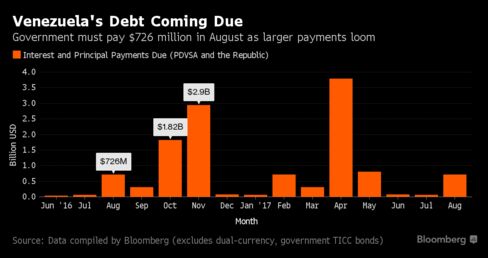
The government and state oil company Petroleos de Venezuela SA need to pay $726 million this month after lighter payments in June and July, according to data compiled by Bloomberg. Attention will now start to shift toward the last quarter of the year, when interest payments totaling almost $5 billion come due.
Whether or not Venezuela can avoid a default may depend on if the government and PDVSA officials can strike a deal to refinance debt coming due over the next year. Rumors are swirling, and investors have been paying close attention. A deal won’t come cheap, though, as PDVSA would need to offer bondholders securities that boost the net present value of their investment.
Bond Prices
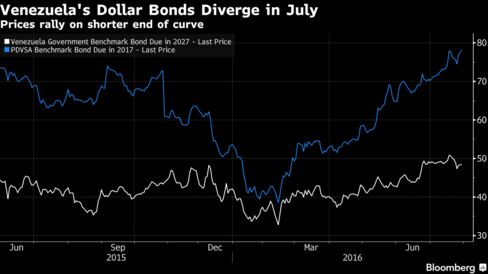
Venezuela’s dollar bonds nearing maturity rallied on speculation of an imminent debt swap, with PDVSA’s bonds due in November 2017 rising 11.3 percent in July to 77.6 cents on the dollar and a yield of 31.5 percent.
Longer-dated bonds were more stable last month. The government’s benchmark notes due 2027 ended the month trading at 48.17 cents on the dollar and yielding 21.8 percent. The price fell about 0.8 percent in July, demonstrating how the volatile situation in the country can create big winners - or losers - on Wall Street, depending on the maturities of the bonds you hold.
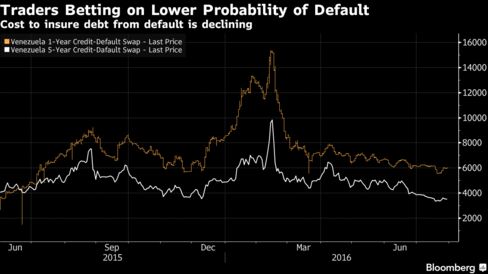
Trading in credit-default swaps show that investors continue to lower short-term default expectations. While Venezuela is still by far the most likely country to default in the world, the implied probability that it happens over the next 12 months fell to 49 percent on July 29 from 56 percent at the end of June and 83 percent in February. The probability of a default in the next five years is 91 percent, according to credit-default swaps. Highlighting the still very real risk of nonpayment, Moody’s Investors Servicewarned on June 20 that it was “highly unlikely” that Venezuela would have enough hard currency to fully make its debt payments this year.
Central Bank Reserves
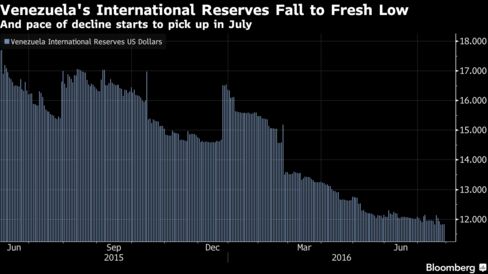
Venezuela’s international reserves fell to a new 13-year low in July, falling below $12 billion for the first time since 2003 to end the month near $11.8 billion. Reserves fell about $247 million in July after declining $68 million in June and $607 million in May, according to data compiled by Bloomberg.
Currency Rates
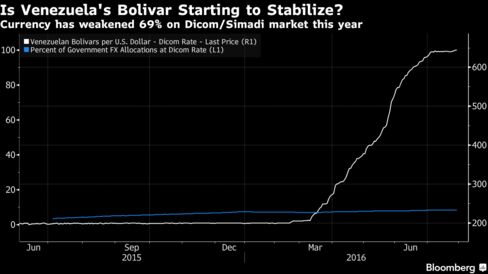
Venezuela’s weakest official exchange rate, used mostly for imports deemed non-essential, stabilized in July, declining only 2.6 percent to 644.3 bolivars per dollar after plunging 15 percent in June and 29 percent in May. The complementary system, known as Simadi or DICOM, accounts for about 8 percent of the government’s hard currency sales. The rest of Venezuela’s greenbacks are sold at the priority rate of only 10 bolivars per dollar.
The devaluation of the currency decelerated to the slowest monthly pace since February, giving credence to economy Vice President Miguel Perez Abad’s comments in a May interview that the DICOM exchange rate was close to reaching “equilibrium.” It still needs to fall another 35 percent before it catches up with the illegal, black-market rate, though.
Crude Prices
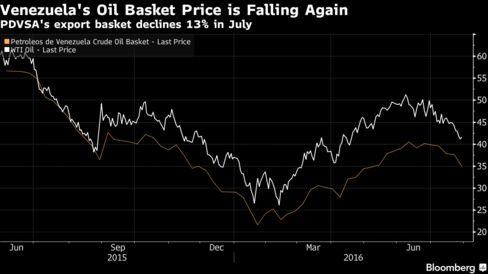
The price Venezuela receives for its oil exports had started to stabilize earlier this year and ended June 66 percent higher from a low in January. It didn’t last. The Venezuela crude oil basket fell 13 percent in July, the first monthly drop since January, ending at $35 a barrel. Still, concerns are starting to grow that overall revenue may suffer as crude output falls. Eulogio Del Pino, the country’s oil minister and president of state-owned producer PDVSA, told Bloomberg Television on June 16 that current oil prices would be enough to avoid a default.
The Latin American Reserve Fund, financed by eight Latin American central banks, last month agreed to lend Venezuela $482.5 million. A growing constitutional standoffbetween the opposition controlled National Assembly and pro-government Supreme Court, however, could increase uncertainty about holding government debt.
Alfonso Marquina, an opposition deputy and head of finance committee, on July 21warned investors that any new debt or restructuring not approved by the national assembly would be null and void.
This week the National Electoral Council is expected to announce the next step required for the opposition in order to proceed with a referendum to recall Maduro as early as this year. His current presidential term doesn’t end until 2019.
Venezuelan bond prices are too attractive to pass up as the country’s dire economic situation will eventually result in reforms that bolster its finances, according to BlueBay Asset Management.
“Valuations are still cheap for a country that has the largest oil reserves in the world and, under better economic management, would be able to comfortably service that debt,” said Graham Stock, the head of emerging-market sovereign research in London at BlueBay, whose flagship fund for developing-nation bonds beat 88 percent of its peers over the past year. BlueBay is a unit of Royal Bank of Canada.
The sustained drop in global oil prices has thrown Venezuela into turmoil, and swaps traders are pricing in a 92 percent chance of default over the next five years as Goldman Sachs Group Inc. says the country is in a “depression” and showing signs of hyperinflation. As political tension increases and protests erupt over food shortages, Stock says he’s betting that policy makers will eventually take steps to normalize the economy. Even if there’s a default, recovery values for the bonds exceed current price levels, according to Stock, who helps manage $16 billion in emerging-market assets.
A default “would be such a catastrophic development for the country as a whole that it would likely be accompanied by regime change and a better mix of policies going forward,” he said in an interview.
For the full Q&A with Stock, click here to read the Bloomberg Brief.
Stock said a proposal for the state oil company to swap bonds that come due in the next few years for notes with longer maturities would make it easier for the country to service its debt. Stock, who holds securities from state-owned Petroleos de Venezuela SA, said he would consider participating in the deal as long as it offered favorable terms on a net-present-value basis.
Bonds from Ecuador, another oil-dependent economy in South America, also appeal to Stock. He says the relatively small amount of debt coming due over the next few years and evidence that the government has been able to invest in improving the country’s infrastructure are positive signals for bondholders.
Overall, Latin America is a “better place” for investors today than it was 12 months ago, Stock said, citing political and fiscal initiatives in Argentina ushered in by President Mauricio Macri since he took office in December, and the beginning of similar changes in Brazil under acting President Michel Temer.
In Argentina, it’s “increasingly apparent that the government is trying to deliver on the commitments it made at the start of its term to do things differently,” he said. He expects Argentina’s sovereign bonds to outperform during the rest of the year, and says provincial notes offer an attractive yield premium.
Brazil’s bonds have room for gains in the second half of the year, after the country’s economic slump hit a bottom in the first quarter, he said. Temer will begin to deliver on efforts to shore up the country’s budget and drive investment into infrastructure that will boost growth, Stock said.