Gesamtzahl der Seitenaufrufe

Mittwoch, 5. Dezember 2018

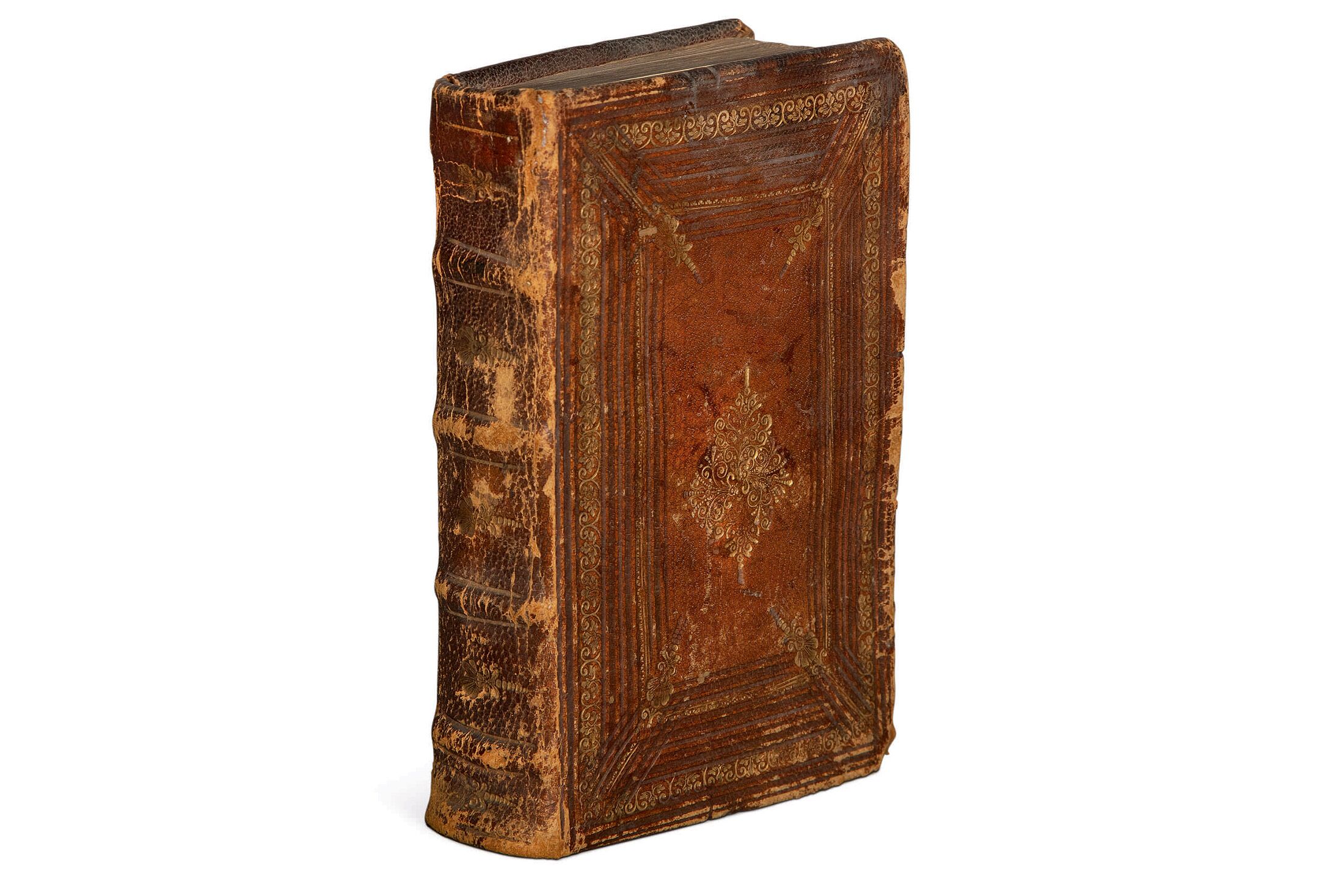
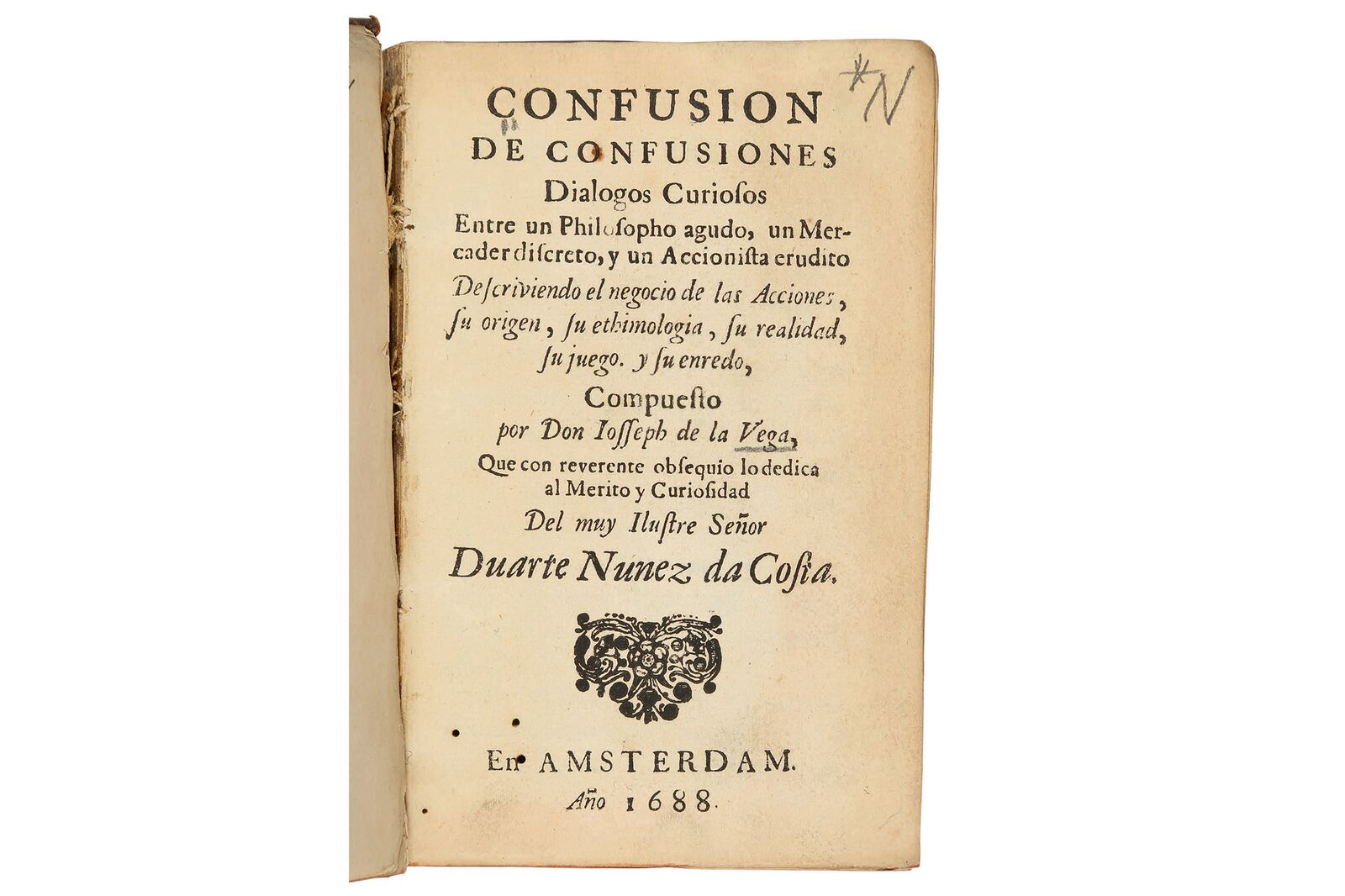
Collecting The First Book Written About a Stock Market Is Selling for $300,000 Joseph Penso de la Vega’s Confusion of Confusions was published in 1688.

Collecting

The First Book Written About a Stock Market Is Selling for $300,000

Joseph Penso de la Vega’s Confusion of Confusions was published in 1688.
The first edition is one of less than 10 in existence. Source: Sotheby’s
On Tuesday the first book known to be written about a stock exchange went on sale at Sotheby’s Rare Books and Manuscripts online auction, carrying an estimate of $200,000 to $300,000. Written by Joseph Penso de la Vega in 1688, the Confusion of Confusions is a primer for the Amsterdam stock exchange, which was set up by the Dutch East India company in 1602. Bids close on Dec. 17.
Vega, a Sephardic Jew who had immigrated from Spain to Amsterdam earlier in the century, wrote the book in Spanish and described the mechanics of the exchange—including descriptions of puts, calls, pools, and manipulations—in addition to providing overall investment advice.
Given  that Vega was writing a book about a Dutch stock exchange in Spanish, it “probably meant it was aimed at the Sephardic community,” says Selby Kiffer, an international senior specialist in Sotheby’s books and manuscripts department who’s in charge of the sale.
In his preface, Vega expresses a desire to dispel “confusion” about the exchange, adding that he’d like to provide a few warnings about less-than-honest practices. He also hastens to add that the book was written for his own enjoyment.
“Vega was not principally a trader himself, but he did trade sometimes and spent time on the market,” Kiffer says. “What’s interesting is that it’s a description from the inside. It was kind of meant to lift the veil and explain what was going on.” 

An Honest Operation

Vega, Kiffer says, “describes the market as an honest operation and an honorable business, but he nevertheless warns readers that there are some people who will try to take advantage of you.” The text is written as a series of dialogues among what Sotheby’s describes as “stock characters,” including a philosopher, a merchant, and a shareholder.
Confusion of Confusions is thought to be the first book about a stock exchange.
Source: Sotheby's
The four principles Vega sets out are reasonably applicable to any amateur trader today:
  • On the off chance that you’re wrong, never give anyone advice to buy or sell shares.
  • Take every gain without showing remorse about missed profits, i.e., don’t kick yourself for missing the absolute peak of a share price.
  • Profits on the exchange are “the treasures of goblins,” meaning a profit today could be a loss tomorrow.
  • Finally, whoever wants to truly thrive as a trader has to have patience and money.
“I think it had a pragmatic purpose,” Kiffer says. “It wasn’t written as a scholarly work. It was intended [for] popular use.”

Less Than 10 Left

Despite its wisdom, not to mention its historic import, the book remained relatively obscure until the late 19th century, when a series of economists—first German, then Dutch—began to draw on the text; the first translation appeared in English in 1959. Today a copy is available in hardcover for less than $30.
The book on sale at Sotheby’s is a first edition. The auction house estimates there are fewer than 10 in existence. The most recent sale of a Confusion of Confusions first edition was more than 30 years ago, when Sotheby’s London sold a volume for £16,500, which at the time converted to about $29,000 dollars.
Given that the current lot’s estimate represents more than a 900 percent appreciation over 30 years, Sotheby’s valuation could be perceived as fairly aggressive, but Kiffer says he thinks it’s conservative. “I’ve certainly seen many books increase in value by that factor over that many years,” he says. “I remember when you could buy a pretty good copy of Darwin’s The Origin of Species for $6,000 to $10,000, and now a pretty good copy is between $150,000 to $200,000.”
The book is being sold by the Jewish Theological Seminary, and Kiffer says that given its lofty price, he’s almost certain it will be sold to a private collector, possibly someone in finance. 
“I think that’s where the interesting competition might occur,” he says. “It could be between established book collectors and people who are interested in approaching it for the content.”

Ein erfischendes Morgen-Highlight das ich gerne lese...

DAS MORNING BRIEFING

Steingart....

04.12.2018
…
dpa
Guten Morgen Rolf Koch,
unbemerkt von der Öffentlichkeit bereiten sich die Finanzminister der Europäischen Union und der EZB-Präsident Mario Draghi auf die nächste Finanzkrise vor. Man kam gestern in Brüssel zusammen, um die „Reform der Eurozone“ zu besprechen und einen „Bericht zur Vertiefung der Währungsunion“ zu verabschieden.

Das klingt nach europäischer Routine und wird von einem schläfrig gewordenen Brüsseler Pressekorps auch liebevoll so beschrieben. Doch in Wahrheit wurden da nicht die unhaltbaren, weil labilen Zustände in der Eurozone reformiert oder gar beseitigt, sondern neue Mechanismen installiert und mit Geld ausgestattet, die genau diese labilen Zustände verlängern.

Es geht in dem Bericht, der den Staats- und Regierungschefs zur Beschlussfassung vorgelegt werden soll, um nichts anderes als die organisatorische und finanzielle Vorbereitung auf den großen Ernstfall: den Zusammenbruch der Anleihemärkte, die dann absehbaren Liquiditätsengpässe einiger Banken und damit einhergehend die Refinanzierungsschwierigkeiten jener Staaten, die schon heute auf immer neue Liquiditätsspritzen angewiesen sind.
…
Der perfekte Sturm, das wissen Olaf Scholz und seine Kollegen sehr genau, ist längst unterwegs. Der europäische Stabilitätspakt wird von elf der 19 Eurozonen-Staaten verletzt. Die weltweite Verschuldung ist seit 2007 bis Ende 2017 um 42 Prozent gestiegen. Die Notenbanken haben den Dollar und den Euroraum mit Billionen neu geschaffenem Notenbankgeld geflutet. Aktienmarkt und Häusermarkt neigen unter diesen Bedingungen zur Blasenbildung. Und jede Blase neigt zum Platzen.

Diese Zustände werden von den europäischen Finanzministern mittlerweile als unabwendbare Tatsache hingenommen. Es geht nicht mehr um die Wiederherstellung von Solidität, sondern um eine neue Kreditlinie für einen erweiterten Krisenmechanismus. Die Notfallplanung sieht vor, dass zusätzliche Milliarden innerhalb von zwölf Stunden – also über Nacht – vom Rettungsschirm in den Bankensektor gepumpt werden können. Die Befassung der nationalen Parlamente ist in diesem Szenario weder möglich noch erwünscht.

Auf das, was der Sicherheit des Bankensystems wirklich dient – also verbindliche Verlustpuffer bei den Banken und Vorgaben für den Abbau fauler Kredite –, konnte sich die Runde nicht einigen. Das Haus Europa wird von den Finanzministern als Kartenhaus gebaut. Der Schutzpatron dieses windschiefen Gebäudes ist nicht Ludwig Erhard, sondern der Heilige Schlendrian.

Russia’s Provocations in the Sea of Azov: What Should Be Done? BY STEPHEN BLANK

NOVEMBER 26, 2018


Seized Ukrainian ships, small armoured artillery ships and a tug boat, are seen anchored in a port of Kerch, Crimea November 26, 2018. REUTERS/Pavel Rebrov
On November 25 Russian vessels blocked Ukrainian ones from entering the Sea of Azov, fired on Ukrainian ships in the Black Sea, rammed some of those ships, seized three Ukrainian ships, and wounded six in these exchanges. Russia also dispatched helicopters to the area to maintain surveillance and fire capability over any approaching Ukrainian vessels. By any standard, these are acts of war. We should remember that the United States went to war with Great Britain in 1812 because of such incidents. Second, Moscow’s claim to own Crimea, the Sea of Azov, and the Kerch Strait as inviolate Russian territory is wholly illegal. Russia’s claims rest on nothing more than force directed against supposedly weaker targets. We can be sure that it would not behave this way toward a NATO ally.  

These actions are also part of its intention to close the Black Sea to foreign shipping in defiance of international convention. They also mark a significant violation of the concept of Freedom of the Seas, a bedrock principle of the international order and US policy for two centuries. Lastly, these actions reflect Moscow’s ongoing efforts to use force and the threat thereof to force Ukraine into submission.

Russia’s actions closely resemble China’s in the South China Sea and the East China Sea. In those cases, Beijing has unilaterally declared sovereignty over these territories, seized plots of land, built up artificial islands, heavily militarized them (as Russia has done in Crimea), and then refused to accept international juridical tribunals’ findings. Now Beijing is using its strengthened hand to coerce other Southeast Asian states into economic agreements on China’s terms in order to explore those areas for potential energy deposits.  In the same way, Moscow seized Ukrainian energy platforms in the Black Sea immediately upon invading Crimea and is profiting from them while trying to suffocate the Ukrainian coastline.

What should be done to counter Russia’s activities? Ukraine is the victim of Russian aggression and has been since February 2014, when Russia invaded Crimea.  Before that invasion, both Russia and Ukraine regarded the waters of the Azov Sea and Kerch Strait as internal waters, an anomalous but internationally accepted legal status. Russia’s claim today that it has total sovereignty over them is baseless and founded merely on force.  

Even though Ukraine is outgunned, it does have options. It can undertake operations to break the blockade, though they would likely be fruitless given the forces Moscow has sent there. Nevertheless, it cannot accept this attack on its sovereignty and integrity passively. Ukraine should give careful consideration to a special operation that might disrupt the bridge that Moscow built over the Kerch Strait that joins Crimea to Russia. But that’s not all. Ukraine should invite the United States and NATO to send a fleet of armed ships to visit Mariupol, the main city on the Sea of Azov coast and defy Russia to fire on or block NATO from exercising the right to visit Ukraine’s ports. Those ships should be armed and have air cover but be instructed not to fire unless fired upon.

Many will object that such an action constitutes a provocation of Russia.

Let’s be clear: Moscow not Kyiv, and certainly not Brussels or Washington, is the provocateur and has raised the stakes. Moscow may be willing to threaten Ukraine in the delusion that more force can give it some concept of victory in Ukraine. But it is in no condition to threaten NATO with such actions. Apart from its economic stagnation and the pressure of sanctions that will be increased due to this action, the Russian public does not want a protracted war against Ukraine. Neither Russia’s military nor its economy can bear those burdens without incurring serious costs that cannot and will not be hidden from ordinary Russians. Given the regime’s fear of an informed public and further economic unrest at home, such a NATO action calls Moscow’s bluff and will go a long way to restoring opportunities for a general reduction in violence. Bringing NATO directly into Ukrainian waters would demonstrate that Putin has not gained Russian lands but lost Ukraine for good and brought NATO into the bargain. It strikes at the political foundations of Putin’s power and belief in NATO’s irresolution without escalating a military challenge. It would also restore escalation control to Ukraine and its allies and drive a dagger into the heart of Russian strategy without resorting to war.  It is time for the costs of Putin’s adventurism to be brought home graphically to him, his entourage, and the Russian people.

Stephen Blank is a senior fellow at the American Foreign Policy Council. He is the author of numerous foreign policy-related articles, white papers, and monographs focused on the geopolitics and geostrategy of Russia and Eurasia. He is a former MacArthur Fellow at the US Army War College.

Montag, 3. Dezember 2018

Danach hat er 2015 – zum Höhepunkt der Griechenland-Krise – mehrmals mit dem ihm sehr vertrauten Wolfgang Schäuble über einen Wechsel des damaligen Finanzministers ins Bundeskanzleramt gesprochen. Merz bot seine Hilfe an (HB Morning)

Danach hat er 2015 – zum Höhepunkt der Griechenland-Krise – mehrmals mit dem ihm sehr vertrauten Wolfgang Schäuble über einen Wechsel des damaligen Finanzministers ins Bundeskanzleramt gesprochen. Merz bot seine Hilfe an (HB Morning)

abläuft.

Diese Woche wird noch einmal zur großen CDU-Beschau mit den Fieberkurven aller drei Kandidaten, die sich am Freitag zum Parteichefwählen lassen wollen. Friedrich Merz überrascht in einer heute Abend ausgestrahlten ARD-Dokumentation noch einmal mit einer zeitgeschichtlichen EnthüllungDanach hat er 2015 – zum Höhepunkt der Griechenland-Krise – mehrmals mit dem ihm sehr vertrauten Wolfgang Schäuble über einen Wechsel des damaligen Finanzministers ins Bundeskanzleramt gesprochen. Merz bot seine Hilfe an – so, wie er jetzt von Schäuble unterstützt wird. Wer von dem Bewerber-Trio am Ende gewinnt, wissen wir nicht. Wir wissen aber, dass schon lange nicht mehr so viel über die Union geredet wurde

Samstag, 1. Dezember 2018

Scientists: Weak Ocean Circulation Could Signify Incoming Mini Ice Age

Scientists: Weak Ocean Circulation Could Signify Incoming Mini Ice Age

A weak circulation of ocean waters in the North Atlantic could signify that a mini ice age is just around the corner.  Scientists have discovered the weakening currents look similar to those that happened right before the Little Ice Age, a cold spell observed between about 1600 and 1850 AD.
During the Little Ice Age, the Baltic Sea, along with many of the lakes and rivers in Europe froze over. And new and recent studies are showing that the currents in the North Atlantic ocean are at their lowest in 1,500 years
Researchers studied the Atlantic Meridional Overturning Circulation (AMOC), the branch of the North Atlantic circulation that brings warm surface water toward the Arctic and cold deep water toward the equator.
The research, co-led by Dr. Christelle Not and Dr. Benoit Thibodeau from the Department of Earth Sciences and the Swire Institute of Marine Science, The University of Hong Kong, is interpreted to be a direct consequence of global warming and associated melt of the Greenland Ice-Sheet.
Slower circulation in the North Atlantic can yield profound change on both the North American and European climate but also on the African and Asian summer monsoon rainfall. –The Daily Mail
Scientists are about to blame a mini ice age on global warming climate change.
“The discovery of this new record of AMOC will enhance our understanding of its drivers and ultimately help us better comprehend potential near-future change under global warming,” said Dr. Thibodeau. 
“While we could ground-truth our temperature reconstruction for the 20th century against instrumental measurement it is not possible to do so for the Little Ice Age period, added Not. “Therefore, we need to conduct more analysis to consolidate this hypothesis.”
This weakening in the current is still vigorously debated because of the scarcity of long-term record of the AMOC.
To read the entire press release, please click here.