Gesamtzahl der Seitenaufrufe

Dienstag, 31. Oktober 2017

Da gibts nochmals Geld


Pdvsa debe pagar este jueves $ 1.121,3 millones del bono 2017

Este desembolso constituye la última amortización de capital e intereses de este título


  • IVONNE AYALA
31 de octubre de 2017 06:40 AM
Actualizado el 31 de octubre de 2017 09:42 AM

PARA COMPARTIR

Pdvsa debe pagar este jueves $ 1.121,3 millones del bono 2017 
Caracas.- Un total de 1.121,3  millones de dólares en liquidación e  intereses  del bono de Pdvsa 2017-8,5% deberá cancelar  la petrolera este jueves,  2 de noviembre, de acuerdo al cronograma de pagos de deuda suscrito por la empresa y la República, recordó este lunes la firma consultora Boungy.
Dicho desembolso constituye la última amortización del referido papel, según observan los analistas.
El pasado viernes 27 de octubre,  Petróleos de Venezuela anunció la transferencia al agente pagador externo JP Morgan  la cantidad de $841,88 millones para proceder a la cancelación de los intereses del Bono PDVSA 2020.
Según se conoció este lunes,  dicho pago podría materializarse en las cuentas de los tenedores mañana miércoles 1 de noviembre, ya que trascendió que el proceso había tardado veinticuatro horas más de lo acostumbrado.
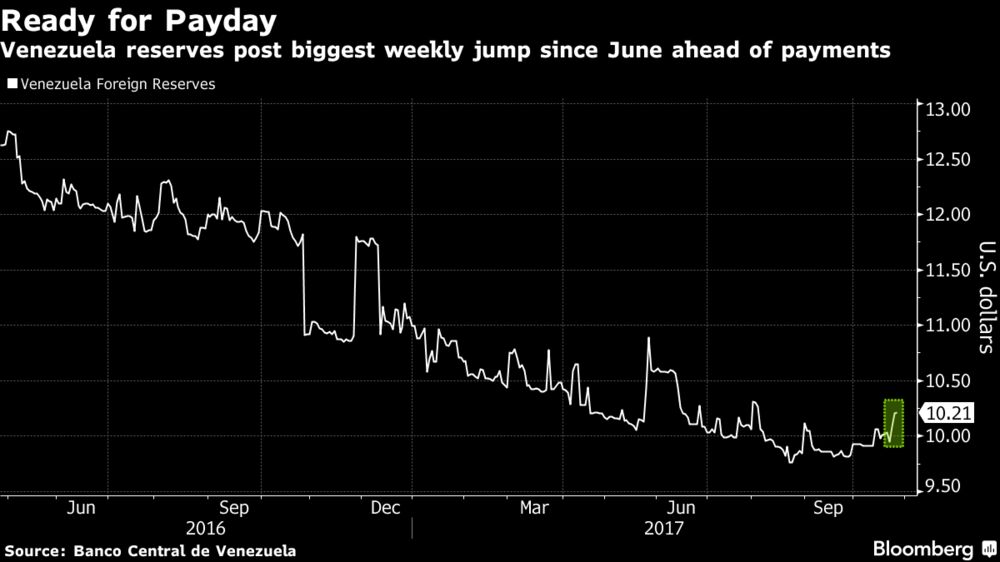
La  referida empresa de análisis coincide con otros expertos en la materia, en señalar que Venezuela enfrenta en el último cuatrimestre de este año, uno de los períodos más exigentes en materia de desembolsos financieros. En tal sentido,   estiman que este período en el que se calcula un total de desembolsos por 4,8 millones de dólares, se constituye en  “una de las más duras pruebas a la voluntad y capacidad de pago de la República”, señala Boungy.
A este respecto, sostienen que los desembolsos en este lapso superaron los ejecutados en el cuarto trimestre del año pasado.
“Para el año 2016, Venezuela pagó por concepto de deuda un total $9.839 millones de los cuales  $4.661 correspondieron al 4to trimestre.  Para el 4to trimestre de 2017 la cifra asciende a $4.762,8 millones, una prueba considerablemente mayor tomando en cuenta el canje del bono Pdvsa2017N y Pdvsa2017-5,25 que dieron nacimiento al bono Pdvsa 2020-8,5”, indica el informe citado.
Y el petróleo al alza
Pasando al mercado petrolero, tenemos que éste sigue exhibiendo una recuperación constante, según observan los entendidos en el sector.
Es así, que uno de los principales propulsores del incremento en promedio del crudo a 60 dólares el barril, lo constituye la expectativa de que finalmente se extienda hasta finales del 2018 el acuerdo de recorte de producción suscrito por la OPEP y sus aliados en diciembre de 2016.
A este respecto, ayer Rusia y Arabia Saudita ratificaron su apoyo a la propuesta que se debate en encuentros bilaterales previos a la séptima reunión del Comité Ministerial de Monitoreo, que tendrá lugar a finales de noviembre próximo.
Expertos en la materia estiman que el mercado percibe este escenario como el más plausible, lo que mantiene el crudo sobre la barrera de los 60 dólares, “cerca de su mayor nivel desde mediados del 2015”.
El grupo consultor internacional, JBC Energy, observó este lunes que la reacción positiva del mercado se sustenta, mayormente, en las expectativas de que el convenio de Viena trascienda la fecha pautada para culminar el período de recorte, inicialmente previsto para finales de marzo de año que viene.
Desde principios de octubre,  tanto   el ministro de Energía saudí, Khalid al-Falih, como su homólogo ruso Alexandr Nóvak, han manifestado publicamente su disposición de apoyar la iniciativa de prorrogar nuevamente la estrategia de recorte empleada para equilibrar al alza los precios del crudo, así como estabilizar el mercado, posición que ha hecho que parezca esta opción la más adecuada para consolidar los logros alcanzados. 
De hecho, el secretario general de la Organización de Países Exportadores de Petróleo (OPEP), Mohammad Barkindo, refrendó que “el apoyo de Arabia Saudita y Rusia a una extensión del acuerdo aclarará el panorama para la reunión que sostendrá el cartel petrolero el 30 de noviembre”, sostuvo

Venezuela and PDVSA together are now behind on nearly $750 million in coupon payments, according to two of the sources, including the missing coupon for the 2020 bond from Friday.

Bondholders yet to receive payment on PDVSA 2020 bond: sources
Corina Pons, Brian Ellsworth
3 MIN READ
CARACAS (Reuters) - Bondholders have not yet received an $842 million payment that Venezuelan state oil company PDVSA said on Friday it had made on its 2020 bond, six market sources said on Monday, further fueling doubts about the cash-strapped company’s finances.

FILE PHOTO: The logo of the Venezuelan state oil company PDVSA is seen at a gas station in Caracas, Venezuela March 2, 2017. REUTERS/Carlos Garcia Rawlins/File Photo
PDVSA [PDVSA.UL] has not in recent memory delayed a principal payment on any of its bonds despite triple-digit inflation and a collapsing socialist economic system. Concerns over possible default have made Venezuela and PDVSA bonds among the highest-yielding of any emerging market securities.

PDVSA on Friday said it had sent the funds to accounts at JPMorgan to cover an amortization on the bond, without saying if it had paid a $143 million coupon due on the same date.

The announcement that the bond would be paid eased worries of default after sources close to the government said it had considered not paying. But it would leave the cash-strapped administration with less cash to attend to economic woes.

One market source said he had been told that the funds were at JPMorgan and that payment would likely be credited by Wednesday, but added that the delay was concerning because “PDVSA has never delayed a principal payment.”


The source said the transfers have never previously taken more than one day to complete.

JPMorgan declined to comment. PDVSA did not immediately respond to an email seeking comment.

The PDVSA 2020 prospectus lists the paying agent - the financial institution which receives funds from the company paying the bond - as Law Debenture Trust Company of New York.

An official for Law Debenture contacted by Reuters last week said the paying agent role had passed to Delaware Trust, which acquired Law Debenture last year.

A public relations manager for digital branding firm CSC, the parent company for Delaware Trust, did not immediately respond to an email asking if Delaware Trust had received the funds and seeking to confirm that it is indeed the paying agent.

Market reaction to the delay was relatively muted compared with wild swings in bond prices last week.

PDVSA bonds were down slightly in afternoon trading, with PDVSA’s 2020 bond 716558AH4= falling 1.375 percentage points to a bid price of 83.750. Venezuela’s sovereign bonds were mixed.

Venezuela and PDVSA together are now behind on nearly $750 million in coupon payments, according to two of the sources, including the missing coupon for the 2020 bond from Friday.

That is the result of repeatedly using the 30-day grace periods for bond interest payments during the month of October.

President Nicolas Maduro says the country is victim of an “economic war” led by political adversaries, and insists default rumors are a campaign against his socialist administration.

His critics say failed socialist policies including price controls, state takeovers of private companies and heavy borrowing during the oil boom are to blame for the OPEC nation’s predicament.

Reporting by Corina Pons and Brian Ellsworth in Caracas, and Paul Kilby and Davide Scigliuzzo in New York, editing by Rosalba O'Brien
Our Standards:The Thomson Reuters Trust Principles.
SPONSORED

Investors Have Yet To Receive PDVSA’s $842M Bond Payment

Investors Have Yet To Receive PDVSA’s $842M Bond Payment

PDVSA
PDVSA’s Friday payment of $842 million on 2020 bond payments has yet to reach investors, according to a new report by Reuters—a fact that does not bode well for cash-strapped Venezuela.
Six market sources told Reuters on Monday that despite the state-run oil company’s claim that the payment went through, bond investors had not yet received their due.
Last Friday, Ray Zucaro, the chief investment officer at Miami-based RVX Asset Management, said: “Given logistics and steps needed to get payment to bondholders, I doubt that the money will arrive by the end of today, Monday is more realistic, and then we will hear a big sigh of relief.”
Caracas owes another big bond payment, which is due November 2nd. So far, it seems the country intends on meeting the no-grace period debt obligation as well.  
“I don’t think we’ll sweat as much going into November 2, given the fact that they’ve made this amortization payment,” Siobhan Morden, of Nomura Securities, told Bloomberg. Still, missing prior interest owed payments of hundreds of millions “reaffirms the coupon watch and concerns that they continue to struggle to make these payments.”
Venezuela has been in a similar situation of payment uncertainty in the recent past, with bond prices plummeting right before a big payment. For example, just before a big principal payment was due in April 2017, Venezuela received a $1 billion loan from Russia just one week before the due date. 
China and Russia have both been eager to help Venezuela in exchange for quick access to the South American country’s oil, as was made clear during U.S. congressional testimonies last Wednesday.
"I would like to emphasize how both Russia and China, in the pursuit of their commercial and strategic interests in Venezuela, have provided capital, goods, services, and political backing that has indirectly enabled the populist regime to ignore and ultimately destroy the mechanisms of democratic accountability," Evan Ellis, of the Center for Strategic and International Studies, told the House Foreign Affairs Committee.
By Zainab Calcuttawala for Oilprice.com
More Top Reads From Oilprice.com:

der Swap vor einem Jahr von A1A25E in A188DW (Laufzeitverlängerung) war nicht schlecht !! mit der erolgten Zinszahlung ein glatter Verdoppler.....absolut + ca 70.000 USD

Katia today


Traders Scramble as Clock Keeps Ticking: Venezuela Default Watch By Ben Bartenstein 30. Oktober 2017, 18:52 MEZ

Traders Scramble as Clock Keeps Ticking: Venezuela Default Watch

  • Five-year implied probability of PDVSA default climbs to 99.5%
  • State oil company faces $1.2 billion payment on Thursday
Mute
Current Time0:35
/
Duration Time2:56
Loaded: 0%
Progress: 0%
 
How Venezuela Has Managed to Avoid Sinking Into Default
The Hurdles Facing Venezuela as It Seeks to Avoid Default
Investors are getting mixed signals as Venezuela stares down billions of dollars in debt obligations over the next few weeks.

The Situation

Although PDVSA said it paid an $842 million principal payment on its 2020 bonds due last Friday, the money has yet to materialize in the accounts of bondholders. Another $1.2 billion payment looms on Thursday. And to top it off, the clock is ticking on more than half a billion dollars in debt from the state oil firm and Nicolas Maduro’s government that are in a 30-day grace period. That said, if Venezuela can survive the next two weeks, it will be smoother sailing until the next big chunk of payments come due in April.

The Bonds

Debtor

Due Date

Amount Due

CUSIP

Cross Default

Grace Period

ELECAR 18sOct. 10$27,625,000EH2888749Yes30 Days
PDVSA 27sOct. 12$80,625,000EG3110533Yes30 Days
VENZ 19sOct. 13$96,718,566EH9901297Yes30 Days
VENZ 24sOct. 13$102,958,473EH9901214Yes30 Days
VENZ 25sOct. 21$61,193,000.25ED8955574Yes30 Days
VENZ 26sOct. 21$176,250,000EI8410553Yes30 Days
PDVSA 20sOct. 27$984,998,482.50 ($841,878,500 in principal)QZ9940003Yes30 Days (for interest payment)
PDVSA 22sOct. 28$90,000,000JV9618804Yes30 Days
PDVSA 17sNov. 2$1,169,075,523.22 ($1,121,415,370 in principal)EI4173619Yes30 Days (for interest payment)

The Investors

Holder NamePercent of Reported TotalLast Filing
Goldman Sachs Group Inc12.5%08/31/17
BlackRock10.8%10/27/17
Fidelity Management & Research9.9%10/27/17
T Rowe Price Group Inc5.7%09/30/17
Ashmore Group Plc5.4%09/30/17
Allianz SE4.1%10/27/17
Grantham Mayo Van Otterloo & Co2.7%05/31/17
Alliance Bernstein2.5%08/31/17
Sun Life Financial Inc.2.5%09/30/17
HSBC2.3%06/30/17
* Based on public filings reported by investment firms and reviewed by Bloomberg.

The Bookshelf

    Before it's here, it's on the Bloomberg Terminal. 
     LEARN MORE